

Gartner® has again recognized Chronosphere as a Leader in the Magic Quadrant™ for Observability Platforms, which we believe validates for the third consecutive year our ability to help enterprises scale reliably while optimizing costs.
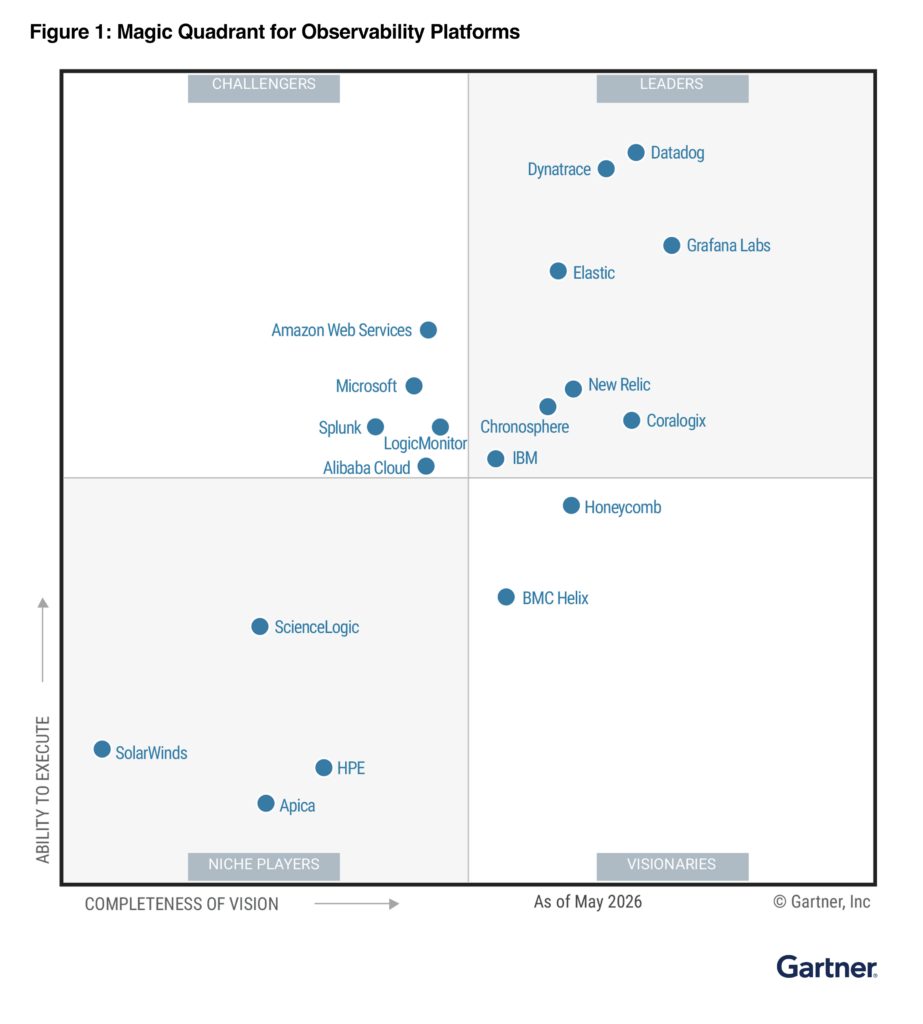
This recognition belongs to our customers, partners, and the dedicated team that pushes our platform forward every day. When we began this journey, our goal was to build an observability platform that solves the challenges created by large-scale, cloud-native environments. We believe being recognized for three years running underscores that our approach continues to match the operational needs of modern enterprises.
In this article, I want to recap all the progress we’ve made over the past 12 months, culminating in this recognition. First, let’s talk about where we started.
Download a free copy of the report
Cost and Scale Differentiation Are Critical for the Cloud and AI-Native Enterprise
Distributed microservice environments produce a massive amount of metrics, logs, and traces. Yet legacy monitoring platforms frequently tie their pricing structures directly to ingestion volumes, essentially penalizing businesses for achieving the visibility they need to operate reliably. In turn, businesses are left with a difficult choice between maintaining critical visibility or experiencing unpredictable overages.
We designed the Chronosphere Control Plane to solve this exact problem, giving teams the tools to proactively manage telemetry data and prevent escalating costs. Our platform actively helps organizations right-size their data, while preserving the visibility they need. On average, our customers optimize their observability data volume by 89%, ensuring they retain valuable operational signals without the financial burden of unmanaged data ingestion.
In the 2026 Gartner® Critical Capabilities™ for Observability Platforms, Chronosphere ranked first for the Observability Cost Control Use Case.
We believe our cost optimization capabilities, combined with our ability to reliably support massive data volumes, established us a strong partner with some of the best cloud-native engineering teams in the world, including DoorDash and Affirm.
We’re seeing that leading AI-native companies also need a cost-effective, highly-scalable observability solution, given the volumes of data they emit and the scale of growth. Chronosphere already provides observability for two of the top five leading AI frontier labs.
Accelerating MTTx with Agentic Artificial Intelligence
As organizations adopt large-scale cloud architectures, it’s increasingly complex to find and fix issues. In a recent survey by theCUBE, over 55% of respondents reported a Mean Time to Resolution (MTTR) above 4 hours. AI increases the number of change events, adding gas to this fire. In November, we announced the early access of AI Guided Troubleshooting to solve this problem.
At its foundation is our Temporal Knowledge Graph, which connects all the telemetry data across a company’s infrastructure, applications and business operations. It also accounts for user input and the institutional knowledge that is collected over time (e.g., Investigation Notebooks, Comments) to build a living, queryable model of how a company’s overall system behaves. We’ve observed that the more complete this Knowledge Graph is—meaning the better the system is presented—the better the results.
What makes our approach differentiated and allows us to have a more complete Knowledge Graph is that it can contextualize data regardless of format or schemas. Other solutions in the market either depend on one of the following:
- Proprietary integrations as their source of data. These solutions often struggle to bring context to custom instrumentation, which ends up being the majority of observability data.
- The customer enforcing strict, consistent schemas across their observability data. We’ve found this assumption to be impractical in large organizations.
Our unique approach not only connects data across varying schemas and naming conventions, but also leverages AI to add meaning and context to the raw data.
In the months since the initial announcement, we’ve also worked closely with our customers to evolve and innovate our approach. One area we’ve evolved is pre-computing environmental data that has a high likelihood of being relevant and durable before it’s stored in our Knowledge Graph. That way, when an alert fires, our sub-agents can gather context and draw information from the Knowledge Graph in a manner that balances both quality and speed:
- Quality: Telemetry data can be notoriously messy, so we sift through as much as possible ahead of time, ensuring our agents run on cleaner data live.
- Speed: The more you can pre-compute ahead of the time, the less time agents have to spend determining how to navigate the data on the fly.
What’s this look like in practice? When building the Knowledge Graph, we continuously work to understand what logs labels tend to show up in the environment and what queries historically delivered actionable insights. With this information, the sub-agent knows to look for the appropriate labels in the logs. It might also, for example, know to avoid searching for ERROR logs, if a specific customer rarely uses them.
On top of this, we’ve begun extending this approach via a native integration with Palo Alto Networks’ Cortex AgentiX. Once a root-cause is verified, this integration enables automated remediation without manual handoffs.
Maximizing Enterprise Viability and Market Growth
Our ability to deliver these outcomes received a massive boost through our $3.35 billion acquisition by Palo Alto Networks in January 2026. This significantly strengthened our financial backing and credibility. In the two quarters since joining forces, our momentum has accelerated, with annual recurring revenue exceeding $300 million in less than a year after surpassing $100 million.
As part of Palo Alto Networks, we are jointly innovating where it adds value to our customers, as evident through the integration with Cortex AgentiX to automate remediation. Even as we scale within a larger corporation, our operational strategy remains clear: Chronosphere continues to operate as a dedicated observability solution with an independent product roadmap. And we remain committed to the white-glove support model that our customers have always known and loved.
Self-Healing Systems: Closing the Loop Cost-Effectively
Looking ahead, the software landscape is shifting as AI increasingly produces code and automates development at an unprecedented scale. The next frontier is to counter-balance this influx of AI-generated output by leveraging AI to resolve system issues without human involvement. However, as we approach this autonomous future, we must do so in a way that doesn’t break the bank. True operational reliability will depend on our ability to ensure these self-healing systems remain financially viable to scale.
Gartner does not endorse any company, vendor, product or service depicted in its publications, and does not advise technology users to select only those vendors with the highest ratings or other designation. Gartner publications consist of the opinions of Gartner’s business and technology insights organization and should not be construed as statements of fact. Gartner disclaims all warranties, expressed or implied, with respect to this publication, including any warranties of merchantability or fitness for a particular purpose.
Gartner and Magic Quadrant are a trademark of Gartner, Inc., and/or its affiliates.
This graphic was published by Gartner, Inc. as part of a larger research document and should be evaluated in the context of the entire document. The Gartner document is available upon request from Chronosphere.

 Blog
Blog